The program will enhance the development of oncology care, thereby, advancing healthcare landscape of the region
Participants will engage in in-depth discussions and demonstrations, ensuring a robust and practical learning experience
BANGALORE, India, June 26, 2024 /PRNewswire/ — Apollo Cancer Centres (ACC), in association with Accuray, a global provider of radiation therapy devices, today announced the launch of India Sub-Continent’s first robotic and stereotactic therapy education centre, Robotic & Stereotactic Radiosurgery program . This initiative will be established at ACC in Chennai and Bangalore, and will provide advanced radiosurgery educational training to radiation oncologists, physicists, radiation therapists, and technologists from India and across the India Sub-continent.
Mr Dinesh Madhavan, President Group Oncology, and International, Apollo Hospital Enterprises Ltd, said, “In the field of cancer care ground-breaking technologies pave the way for highly personalized and effective treatment. The inception of the Robotic Stereotactic Radiotherapy Program by Apollo Cancer Centres and Accuray will advance training facilities for the ASEAN region. It will help equip oncologists, physicists, and therapists with the critical knowledge and skills needed to leverage the latest in CyberKnife technology. “
Dr Sridhar PS, Lead- Cyberknife – Robotic Radiosurgery, said, “The launch of the training program at Apollo Cancer Centre is an exceptional opportunity to enhance skills and knowledge in Robotic & Stereotactic Radiotherapy . Since pioneering the Cyberknife Robotic Radio Surgery System in India and a rich experience of over 5000 patients, we will now share the valuable knowledge in the training program. It will enable oncologists in the development of Cancer care through Cyberknife training.”
Ms Suzanne Winter, President & CEO, Accuray, said, “Accuray celebrates the expansion of the CyberKnife® S7™ System to Apollo centers in Chennai and Bangalore, showcasing our enduring collaboration with Apollo Hospitals to enhance cancer care in India. With its unparalleled precision, the CyberKnife S7 System redefines treatment standards, empowering clinicians to optimize outcomes. Additionally, it enables the delivery of high doses of radiation, typically in 1 to 5 sessions for fast and effective treatments, marking a significant advancement in cancer therapy.”
The CyberKnife System is a non-invasive, robotic radiation therapy device designed to treat tumors with high precision and minimal damage to surrounding healthy tissue. It uses advanced imaging and computerized robotics to deliver highly focused beams of radiation, allowing for the treatment of complex and hard-to-reach tumors.
With an aim to provide a world-class comprehensive ‘Educational Center’, the Academia will benefit aspiring CyberKnife clinicians of India and the Subcontinent.
By bringing such a high-caliber educational initiative to India, Apollo Cancer Centres continues to lead the way in medical innovation, dedicated to enhancing the skills of healthcare professionals and ultimately, improving patient outcomes across the country.
#WinningOverCancer
About Apollo Cancer Centre – https://apollocancercentres.com/ THE CANCER CARE LEGACY: BREATHING HOPE INTO LIVES FOR OVER 30 YEARS
Cancer care today means 360-degree comprehensive care, which requires commitment, expertise, and an indomitable spirit from cancer specialists.
Apollo Cancer Centre has a network across India with over 325 oncologists to oversee the delivery of high-end precision Oncology Therapy. Our oncologists deliver world-class cancer care following an organ-based practice under competent Cancer Management Teams. This helps us in delivering exemplary treatment to the patient in an environment that has consistently delivered an international standard of clinical outcomes.
Today, people from 147 countries come to India for cancer treatment at Apollo Cancer Centre. With the first and only Pencil Beam Proton Therapy Centre in South Asia & Middle East, Apollo Cancer Centre.
It might sound uncomfortable, but some women prefer to wear a bra that makes their larger busts a little less prominent in certain outfits. That’s where a well-designed minimizer bra can be a lifesaver. Of course, minimizer bras should limit bouncing and make your chest appear a bit smaller overall, but you aren’t likely to wear them unless they’re also stylish and comfortable. That’s where we come in.
We scoured the internet for the best minimizer bras that contain bounce and leave you with a smooth base for your clothes to fit and flatter. And to do that, we consulted bra fitters, designers and our own team of shopping experts to come up with the best options on the market today. We also dug deep into customer reviews to see what women thought about each of the bras that made it onto our radar. From comfortable seamless options to pretty feminine styles, these are the 10 best minimizer bras to shop for 2024.
Table of contents:
Best minimizer bra overall
Vanity Fair
Fabric: 78% nylon, 22% spandex | Sizes: DD to H | Colors: 20
If you’re aiming to downplay your cup size, this minimizer from Vanity Fair may be just what you’re looking for. This full-coverage bra, also a pick on our overall Best Bras list, can minimize your bustline by up to 1.5 inches. Along with a built-in underwire, it boasts non-padded cups that comfortably cover and support your breasts.
“Depending on the bra style and if you need a larger cup size, you might look for side panels or a wide back band and straps,” said Elisabeth Dale, author of The Bra Zone and founder of The Breast Life. “These details are more critical in bras for people with fuller busts (anything over a DD).” This bra delivers, with extra side and back bands made from a four-way stretch material that smooths any bumps and bulges.
One happy customer reported: “Full coverage, minimizing and comfortable! Best bra I’ve found in a long time. I am very large-chested, and it is extremely difficult to find comfortable, affordable and nice bras! This checks all the boxes!”
Fabric: 87% nylon, 13% elastane | Sizes: A to H | Colors: 7
Kimmay Caldwell, undergarment educator at HurrayKimmay.com, said you don’t have to choose between fashion and function — especially when it comes to this pretty minimizer bra. “This one comes in fun colors and has a shiny cup! So fun. It has thinner straps, a cute applique, and the cups really get the job done. It’s slightly less full coverage than some other styles,” she said.
The cups are unlined and have no padding, so they add support without adding any bulk. This seamless bra is also designed to reduce breast size by up to half a cup without flattening your chest.
“This bra is so comfortable and so beautiful,” raved one shopper. “I cannot [believe] that at a size 38G, I have found a bra that fits this well and comes in such amazing colors with such a beautiful strap! I am so happy!”
Fabric: 34% polyester, 41% nylon, 25% elastane | Sizes: C to H | Colors: 2
Dora Lau, founder of Dora L International, an intimate apparel design, development and sourcing company, is a big fan of this Soma minimizer. “It does a great job of minimizing your shape and is super comfortable for all-day wear,” she said. Its Powermesh wings and U-shaped back work together to smooth you out and leave an even base for clothing.
“This is no joke, this has to be the best-fitting bra I have ever had in my entire life,” raved one shopper. “I’d bought one to try it out, and within three days I ordered two more online. It’s amazing how well this fits me and my only regret is that I didn’t purchase these sooner.”
Fabric: 62% nylon, 38% spandex | Sizes: C to J | Colors: 14
Caldwell swears by this well-loved Wacoal bra for minimizing your chest up to 1 inch while maximizing comfort. Not only does it fit like a second skin, fans say, it has a breathable mesh back to prevent bulging. It also made our list of Best Support Bras.
This bra is also a hit on Amazon, with over 2,000 five-star ratings. One fan reports: “So comfortable. I wish I knew about minimizer bras years ago. Makes my chest look smaller, and super-comfortable. It is also pretty. Good riddance, Victoria’s Secret.”
Fabric: 71% nylon, 29% spandex | Sizes: C to G | Colors: 2
Two of our experts recommend this style from Wacoal. As Lau puts it, “It’s a really effective minimizing bra.” Caldwell agreed, saying, “Wacoal is great at making minimizers. Though this one is plain, it’s highly effective and has a great size range. The scalloped straps also avoid any bra slider mishaps. Plus, the cup is firm.” According to the brand, the bra can reduce the bustline by up to 1 inch. The thick straps are fully adjustable, and there is a hook-and-eye back closure for a customized fit.
“I’m a longtime customer of Wacoal’s minimizer bras and this one is the best,” raved one customer. “Fit is comfortable, great support and looks good with my clothes.”
Fabric: 48% polyester, 36% polyamide, 16% spandex | Sizes: D to H | Colors: 5
This T-shirt bra promises to reduce your bust by one cup size. “Many minimizers are known for being boring, but this is so pretty with a smooth cup that can go underneath anything,” Caldwell said. It has a built-in underwire for added support and adjustable straps to help you find your ideal fit.
“I’ve tried (seriously) at least 30 bras, all styles, sizes, prices, wired, not wired, full, minimizer … you name it. This is the first minimizer bra that (1) did not flatten me out (2) or leave me looking saggy,” raved one reviewer. “This lifted my breasts where they needed to be and gave them a sort of cone (not pointy, just not flat) rather than a flatter, rounder shape. Looks so good under clothes. The sides are high enough without being overkill, the straps are nice and wide, but not too much, and I like that it has two rather than three hooks. The lace is pretty but subtle.”
Fabric: 76% polyamide, 24% spandex | Sizes: C to I | Colors: 12
This Chantelle bra is a favorite of experts and Amazon shoppers alike. “This is a breathable, really wearable minimizer that works as a great everyday bra. The print is pretty but smooth, the straps are thin but offer great adjustability and the cup size range is impressive,” Caldwell said. The unlined minimizer has a leotard-style U-shaped back for extra support, and the seamless design makes it comfortable enough to wear all day.
“Great bra — perfect for tee shirts or anything where you prefer a seamless look,” wrote one five-star reviewer. “No band at the bottom of the cups to curl or dig. Great fit and support, very comfortable, the cups have two layers of fabric (no foam), does give some minimizing effect. I love this bra and will definitely buy again.”
Fabric: 86% nylon, 14% spandex | Sizes: D to G | Colors: 3
Looking to make your bust and sides appear smaller? Lau recommends this Soma bra, which she said “is a great side-slimming bra and has a lot of comfort features.” The seamless, unlined, double-ply cups promise to reduce the bust by up to 3 inches, while the ultra-wide padded wings help smooth out lumps and bumps underneath your clothes.
“Did everything it said it would — slimmed down my sides and greatly reduced my bust — best minimizer bra ever,” raved one shopper.
Fabric: 84% polyamide, 16% spandex | Sizes: A to G | Colors: 19
Want to minimize your bust while wearing a strapless top? Amazon shoppers say it’s possible with this Delimira bra. The non-padded cups compress your chest, while the nonslip silicone lining keeps the bra in place and prevents it from sliding down. It has built-in underwire and side boning for extra support, and it comes with removable straps for when you need even more.
“I normally only buy expensive minimizer bras, as I feel that they give the best reduction,” wrote one reviewer. “I also am weary of strapless bras as it’s hard to hold up DDs without slipping. However, this bra totally delivered. True to size, super comfy, supportive, never slipped, and minimized!”
Pros
Removable straps
Comfortable
Stays in place
Light compression
Cons
Doesn’t look as good with the straps on, some shoppers say
Fabric: 49% polyamide, 36% polyester, 15% spandex | Bra sizes: B to J | Colors: 12
All-around support is crucial when you’re working out, and this underwire bra with wide, cushioned straps claims to reduce bounce by 83%. It also has encapsulated cups that support and compress each breast individually to prevent the dreaded “uniboob” look that even the best sports bras can create. Transform it into a racerback bra with the use of a J-hook. Smooth, flat seams aim to prevent chafing during workouts.
“I don’t know how they did it, but this bra has managed to be supportive and flattering at the same time, which I have yet to find in a sports bra up until now,” raved one shopper. “Very minimal bounce when running. Comfortable to wear and my boobs look so perky in it!”
There are a few key factors to consider before you shop for your next bra, experts say.
Wings and back: The key to a good minimizer is that it reduces a projected shape into a more rounded one, Lau said. “The wing is the most important part of the bra because it anchors the bra — without it, the lift and support will be compromised. The back should be more of a ‘V’ shape, which will cinch things in.”
Underwire: Caldwell said she prefers to fit folks with an underwire minimizer bra for the best effect, but there are wire-free options if you would rather prioritize extra comfort.
Cup material: Since the material of the cup makes up 80% of the bra, the right fabric is key. Lau suggested “looking for a material that’s less stretchy, or more rigid and minimal stretch.” Caldwell agreed: “While you may find a more flexible style, the material should be manufactured with little to no stretch, so it can slightly compress and contain the bust,” she said.
Straps: Wider straps will make a minimizer bra extra comfortable and give additional support, our experts said. In particular, Lau recommended wide straps without stretch, saying they’re more likely to give you the all-day lift and support you need.
Neckline: “The neckline should not be cut in,” Lau said. A higher neckline will help contain the breast tissue and minimize the look of your cup size.
Size: As with any bra, finding your correct size is essential for staying comfortable and supported. “Bras are like shoes — the wrong size will feel awful,” Caldwell said. Not up for a professional fitting? See below for more on how to measure your size at home.
How we chose
To figure out which minimizer bras are the best of the best, we talked to bra experts, fashion designers and our own team of shopping experts. We also asked which options are in their own lingerie drawers, because there’s nothing like a recommendation from someone who actually wears the bra themselves.
FAQs
What is a minimizer bra and how does it work?
A minimizer bra is designed to do exactly what its name suggests: minimize your cup size to make your bust appear smaller. “Minimizer bras … compress and reshape the breasts and silhouette for larger figures,” Lau said. “They offer reduction of bust projection and reshaping for those who have a fuller and softer bust. These bras usually have fuller coverage, so [they go] higher to contain the flesh on the upper bust.”
Minimizers gently press on and redistribute the breast tissue away from the center of the body and closer to the chest. “This is accomplished by cup design, and sometimes a small amount of compression (not like a sports bra, though),” Caldwell said. “This can mean a minimizer will move the bust tissue toward the sides of the chest.” In short, it does the opposite of creating cleavage.
Are minimizer bras comfortable? Can you wear one every day?
While you may think a bra that compresses your breasts would be uncomfortable or unsafe for everyday wear, Caldwell said that’s not the case. “Minimizer bras are often a go-to basic bra for many folks, especially if the neckline of their clothing can accommodate fuller-coverage cups. The key to a comfortable bra is always a good fit — minimizer or not.” Lau agreed: “Minimizers are meant to be worn every day, and should also minimize any breast bounce — a firmer cup and a supportive bra back will achieve this. As long as the bra cup encompasses the breast tissue, does not dig into the flesh and the wire is not sitting on the breast tissue, a minimizer bra should be comfortable,” she said.
How should a minimizer bra fit?
“A good fit means a comfortable snug band that is not too restrictive, and cups that simply reshape the bust, redistributing the tissue rather than squashing it,” Lau said. “A minimizer bra should make your bust look one to two cup sizes smaller, especially if you are a size DDD or larger. The most important thing is that you should not feel squashed or uncomfortable.”
“It’s especially important for a minimizer bra to fit flush with the body,” Caldwell added. “A loose band, straps or cup will result in a less-than-desired effect, not to mention discomfort all day long.” She also advised that “a minimizer bra is not a magic wand and will not instantly make your bust suddenly smaller. It might provide the illusion of a less-full bust without cleavage or forward projection. But it can always make [breasts] appear wider, as the breast tissue is moved out to the sides. Minimizers are most handy to avoid puckering on button-up blouses, or if someone prefers a less-full look in the middle of the body.”
How do I measure my bra size?
While visiting a professional bra fitter is always an option, it’s possible to get an accurate size at home, experts say. “First, you will need a tape measure (measuring unit should be inches) in order to take your rib and bust measurements,” said Noemi Diaz-Justino, senior design director of lingerie brand True & Co. “Holding the tape measure parallel to the floor, wrap it snugly (not tight) around your rib cage. If the measurement is an odd number, add 5 inches. If the measurement is an even number, add 4 inches. Next, keeping the tape measure parallel to the floor, wrap the tape measure loosely around the fullest part of your bust. Now subtract the rib measurement (with the added inches) from the bust measurement. The difference will determine your cup size. The guide for cup sizes goes like this: 1 inch = A cup, 2 inches = B cup, 3 inches = C cup, 4 inches = D cup, 5 inches = DD, 6 inches = DDD.”
Meet our experts
The reviews quoted above reflect the most recent versions at the time of publication.
An Airbus A340-300 and an Airbus A 321-100 belonging to Lufthansa are parked on the airport apron.
Helmut Fricke | Picture Alliance | Getty Images
German airline company Lufthansa Group said Tuesday it would add an “environmental cost surcharge” to ticket prices as soon as this week, which could be as high as 72 euros ($77) for some flights.
“The surcharge is intended to cover part of the steadily rising additional costs due to regulatory environmental requirements,” Lufthansa said in a statement, pointing to regulations from the European Union and International Civil Aviation Organization.
The additional cost will be applied to fights departing from any of the 27 member countries of the European Union, as well as the U.K., Norway and Switzerland, Lufthansa said. All flights sold or operated by Lufthansa Group, which owns airlines including Lufthansa, Eurowings, Swiss and Edelweiss Air, and Austrian Airlines, will be subject to the charge.
“The amount of the surcharge varies depending on the flight route and fare and is between 1 euro and 72 euros,” Lufthansa said, adding that the exact amount would be visible to customers during the booking stage.
The fee will be applied to all tickets issued from June 26 — Wednesday of this week — that are for flights departing from Jan. 1, 2025, Lufthansa said.
Environmental regulations
Several regulations from institutions including the EU would increase costs for airlines, Lufthansa said.
This includes EU quotas for how much sustainable aviation fuel is used. These are set to come into effect in 2025 and increase over the years until 2050.
Sustainable aviation fuel is an alternative to fossil fuels, and can be made of products such as waste oil and fats, nonfood crops, and other waste materials. It can also be created in a process that captures carbon from the air.
The International Air Transport Association says sustainable aviation fuel could cover around 65% of the emissions reduction the aviation industry needs to achieve to reach net zero by 2050.
Lufthansa said Tuesday that the quotas would “lead to additional costs in the billions in the future.”
The company also pointed to the emissions trading systems from the EU, Switzerland and U.K. as a factor in its increasing environmental costs. These programs control and limit the amount of permitted emissions, with the overall cap set to decrease over time with the goal of emissions being lowered.
Lufthansa said it was investing heavily in technology to make aviation more sustainable and supporting climate research.
“However, the airline group will not be able to bear the successively increasing additional costs resulting from regulatory requirements in the coming years on its own. Part of these expected costs for the year 2025 are now to be covered by the new Environmental Cost Surcharge,” the company said.
Prioritises pre-emptive care for three early risk conditions with continuous support throughout the health journey
Study reveals that nearly 90% of Hong Kong residents are not fully aware of their health conditions, putting them at higher risk of critical illness as early disease signs go undetected
HONG KONG, June 25, 2024 /PRNewswire/ — AXA Hong Kong and Macau (“AXA”) unveiled its new TotalAssure Critical Illness Series (“TotalAssure Series” or “New Series”) to provide comprehensive protection for customers against 135 illnesses. The New Series innovatively offers protection for early risk conditions[1] linked to colorectal cancer, breast cancer and heart disease, helping the insured to stay ahead of these critical illnesses while offering timely support for early intervention. It provides up to 1,300% of the sum insured for continuous coverage of increasingly prevalent major illnesses like severe dementias, as well as common critical illnesses that carry significant risks of recurrence, such as cancers and strokes[2].
TotalAssure Plus – BabyPro (“BabyPro”), part of the New Series, offers expectant mothers maternity protection starting as early as 18 weeks of pregnancy. BabyPro provides coverage for pregnancy complications, and innovatively extends coverage to postpartum depression for both mothers and fathers. It enables newborn children to enjoy market-leading double protection during the first policy year.
Addressing the challenge of Hong Kong people overlooking early health risks through pre-emptive care and treatment
AXA’s latest study[3] revealed that nearly 9 out of 10 respondents (86%) were not fully aware of their health conditions (including cancer index, heart function, blood index, liver, gallbladder, kidney function, etc.). Over 60% (63%) of the respondents do not have the habit of getting annual health checkups, while 61% said they would not seek professional medical advice immediately in case of noticing a health problem. In the unfortunate event of a critical illness, 77% of the respondents said their choice of treatment would depend on the financial burden, and over 80% (84%) were worried that they could not afford the treatment cost and ongoing rehabilitation.
Janet Lee, Chief Life and Health Insurance Officer, AXA Hong Kong and Macau, said, “AXA’s critical illness insurance products have consistently led the market with our “Continued Protection,” offering peace of mind to our customers. The newly launched TotalAssure Critical Illness Protection Series not only innovatively incorporates continuous compensation for stroke, but also breaks new ground by providing advanced protection for specific early-stage risks associated with the three most common critical illnesses, while also expanding the scope of surgical coverage. These innovations aim to protect customers before their conditions worsen, effectively addressing market demands and ensuring comprehensive protection and support before, during, and after the onset of serious diseases.”
Comprehensive protection with coverage for 3 early risk conditions, multiple claims and continuous support
With the innovative product design, TotalAssure Series offers enhanced protection for early risk conditions associated with three common critical illnesses that require specific surgeries. These include precancerous lesion of the breast[4], the early high-risk conditions linked to colorectal cancer and heart diseases, such as Colorectal Serrated Adenoma/polyp(s) and cardiomyopathy (Early Dilated). The New Series also expands the coverage to 51 critical surgeries, supporting customers for early illness intervention.
The TotalAssure Series goes beyond traditional critical illness products with continuous coverage for other serious illnesses, offering support and protection for customers throughout different treatment stages. In the unfortunate event of a critical illness, the New Series provides multiple continuous coverage for common critical illnesses with high recurrence rates, such as cancer, heart attack and stroke[2]. The coverage includes a Continuous Cancer Payout for up to 111 months, an additional 5% of the sum insured per month for up to 11 months after a stroke[2] diagnosis, and a payment of 100% of the sum insured, providing stable financial support during the crucial recovery period. Additionally, the New Series provides annual payouts of up to 12% of the sum insured until the age of 100 in the case of severe dementias.
Innovative baby and maternal care package with enhanced special support
With BabyPro, AXA is extending pre-emptive care and continuous protection to mothers and babies. The study mentioned above found that it has become mainstream for expectant parents to purchase insurance for their unborn children (73%). BabyPro accepts applications as early as 18 weeks into pregnancy. In addition to maternal death cover, it offers protection for pregnancy complications and postpartum depression for both parents, with up to HKD2,000 per visit to specialist in psychiatry or registered psychologist, subject to a maximum of 50 visits in total under all TotalAssure Plus – BabyPro policies. BabyPro also covers babies for undetected congenital conditions from birth, giving them protection as soon as they are born and allowing them to enjoy double coverage during their first year as they start their new lives.
Responding to the growing number of special educational needs (“SEN”) students, the TotalAssure Series offer a distinctive protection plan. It provides special educational support for children with conditions such as Attention Deficit Hyperactivity Disorder (ADHD), autism, visual or hearing impairments, ensuring the insured children receive the support they need throughout their educational journey.
The above information is for reference only. For more information on product features, contents, terms and conditions and exclusions, please refer to the product brochure and policy terms and conditions.
The TotalAssure Series offers a comprehensive range of benefits, including:
• Three Key Early Detection and Treatment
Covers for early-risk conditions of three critical illnesses requiring specific surgeries, such as for precancerous breast lesions (unique to the market), early risks of colorectal cancer and heart disease, including Colorectal Serrated Adenoma/polyp(s) and Cardiomyopathy (Early Dilated).
Covers 72 minor illnesses to 63 major illnesses. Based on claim data and experience, combined with the complex surgery list from the Voluntary Health Insurance Scheme (VHIS), the coverage for major surgeries has been expanded from 22 to 51 procedures to encourage early intervention.
BabyPro offers the market’s earliest coverage, accepting applications from as early as 18 weeks into pregnancy. It provides coverage for pregnancy complications, as well as the benefit of postpartum depression coverage for expectant parents, and a full premium waiver in case of maternal death. It also offers the market’s highest double coverage during their first policy year.
• Three Ongoing Support
Comprehensive coverage offers up to 1,300% of the sum insured, providing multiple continuous coverage for common critical illnesses with high recurrence rates, such as cancer, heart attack and strokes[2]. It includes Continuous Cancer Payout for up to 111 months, an additional 5% of the sum insured per month for up to 11 months after the diagnosis of stroke[2] and payment of 100% of the sum insured, which provides stable financial support during the critical recovery period, and an additional annual payout of up to 12% of the sum insured to the age of 100 in the case of severe dementias.
• Recognises the unique challenges of children with Special Educational Needs (“SEN”) and provides special education support for nine conditions if the insured is diagnosed between 6 and 18 years’ old, and attends a special school for one academic year.
• Combines Critical Illness Benefit and Mental Health Services to ensure the insured can attend free mindfulness classes[5], including the YMCA Art Workshop or Pure Yoga Class/Fitness Pass, for mental health protection. Includes different support services for the insured person and their carers after diagnosis of a critical illness.
AXA unveils its TotalAssure Critical Illness Series to comprehensively protect customers against 135 illnesses. (From left to right) Janet Lee, Chief Life and Health Insurance Officer, AXA Hong Kong and Macau; Sally Wan, Chief Executive Officer, AXA Greater China; Grace Chan Hoi-lam, renowned actress; and Jonathan Li, Chief Distribution Officer, AXA Greater China, team up to promote early detection and treatment of illnesses at the launch ceremony.
About AXA Hong Kong AXA Hong Kong and Macau is a member of the AXA Group, a leading global insurer with presence in 51 markets and serving 94 million customers worldwide. Our purpose is to act for human progress by protecting what matters.
As one of the most diversified insurers in Hong Kong, we offer integrated solutions across Life, Health and General Insurance. We are the largest General Insurance provider and a major Health and Employee Benefits provider. Our aim is to not only be the insurer to provide comprehensive protection to our customers, but also a holistic partner to the individuals, businesses and community we serve. At the core of our service commitment is continuous product & service innovation and customer experience enrichment, which is achieved through actively listening to our customers’ needs and leveraging and investing in technology and digital transformation.
We embrace our responsibility to be a driving force against climate change and a force for good to create shared value for our community. We are proud to be the first to address the importance of mental health through different products and services and thought leading iconic research. Our overall Sustainability Strategy, with emphasis on climate strategy and biodiversity commitment, is developed based on TCFD recommendations. We are committed to integrating environmental, social and governance factors across our business and strive to contribute to a sustainable future through 3 distinct roles – as an investor, insurer and an exemplary company.
THIS PRESS RELEASE IS AVAILABLE ON AXA’S WEBSITE: [AXA.COM.HK]
IMPORTANT LEGAL INFORMATION AND CAUTIONARY STATEMENTS CONCERNING FORWARD-LOOKING STATEMENTS
Certain statements contained herein may be forward-looking statements, including, but not limited to, statements that are predictions of or indicate future events, trends, plans or objectives. Undue reliance should not be placed on such statements because they are subject to known and unknown risks and uncertainties and can be affected by other factors that could cause AXA’s actual results to differ materially from those expressed or implied in the forward-looking statements. Please refer to Part 4 – “Risk factors and risk management” of AXA’s Universal Registration Document for the year ended December 31, 2019, for a description of certain important factors, risks and uncertainties that may affect AXA’s business, and/or results of operations. AXA undertakes no obligation to publicly update or revise any of these forward-looking statements, whether to reflect new information, future events or circumstances or otherwise, except as part of applicable regulatory or legal obligations.
[1] Three early risk conditions include cardiomyopathy (early dilated), colorectal serrated adenoma/polyp(s) and precancerous lesion of breast.
[2] Only applicable to TotalAssure Plus Critical Illness Plan and TotalAssure Plus Critical Illness Plan – BabyPro.
[3] The survey was commissioned by AXA and conducted by the market research firm YouGov in April 2024, aimed to study Hong Kong people’s understanding of their own health conditions and stress levels. A total of 1,035 respondents aged between 18 and 50 participated in the survey.
[4] The term ‘market-first’ refers to same type of critical illness insurance plan available for new business in the market that offers lumpsum payout for precancerous lesion of breast (according to AXA internal market research conducted as of 24 June 2024).
[5] The value-added services are provided by third-party service providers as AXA may designate from time to time. AXA shall not be responsible for any value-added services so provided or any act or failure to act on the part of the third-party service providers. The third-party service providers are solely responsible for all obligations and liabilities relating to such value-added services and all auxiliary services so provided. All matters and disputes are subject to the final decision of AXA and the third-party service providers.
JAKARTA, Indonesia, June 25, 2024 /PRNewswire/ — The Ministry of Tourism and Creative Economy/Tourism and Creative Economy Agency (Kemenparekraf/Baparekraf), through the Wonderful Indonesia brand, has launched the activation program “Wonderful Indonesia Co-Branding School Break 2024” titled Co-branding: Travel Responsibly to introduce green and sustainable tourism during the school holiday season.
Ministry of Tourism and Creative Economy Launches “Wonderful Indonesia Co-Branding School Break 2024” during School Holiday Season
Minister of Tourism and Creative Economy/Head of Tourism and Creative Economy Agency (Menparekraf/Kabaparekraf) Sandiaga Salahuddin Uno during “The Weekly Brief with Sandi Uno” at Gedung Sapta Pesona, Jakarta, on Monday (24/6/2024), explained that the “School Break” program offers educational tourism as an alternative choice during school holidays.
This initiative aims to provide educational experiences to tourists, especially the youth, regarding environmental impact and the creative reuse of used products.
“And this will be in four cities that we will visit in June-July, Jakarta AQuarium and Safari, Saung Angklung Udjo Bandung, HeHa Stone Valley Yogyakarta, and Beachwalk Shopping Center Bali,” said Menparekraf.
This school holiday period not only takes place in Indonesia, but also abroad, thus potentially becoming an alternative tourism option for foreign tourists visiting Indonesia.
This activation involves 21 co-branding partners collaborating as venue providers, product waste providers, waste management hub service providers, cargo service providers, game prize providers, and post-event upcycling practitioners.
Among the co-branding partners are Jakarta AQuarium and Safari, Saung Angklung Udjo, HeHa Stone Valley, Beachwalk Shopping Center, Aice, Paxel, Dagadu Djokdja, Dama Kara, Bodypack, Pipiltin Cocoa, Finna Food, Lokalate, BEJO Jahe Merah, El Hotel Group, AVO Group, Rumah Atsiri Indonesia, homLiv, Gofress, Grab, Pala Nusantara, and Bank Sampah Bersinar.
Deputy Marketing Director of Kemenparekraf/Baparekraf, Ni Made Ayu Marthini, conveyed that event visitors can view an upcycle installation exhibition featuring creative art made from used products resulting from the business activities of co-branding partners.
“We also have a waste bank, which will also create installations using the collected waste, so there will be many activities that we will do together with co-branding partners,” said Made.
In addition to the Upcycle Installation Exhibition, visitors can also learn about waste management and participate in prize games. This event is expected to inspire the creation of green and sustainable tourism for tourists.
Regarding Co-Branding Wonderful Indonesia
Co-branding represents a strategic collaboration between Wonderful Indonesia and a range of entities from tourism and non-tourism sectors, including hotels, restaurants, food and beverages, manufacturing, and FMCG (Fast Moving Consumer Goods). This partnership, based on collaboration, welcomes industrial partners interested in contributing to Indonesia’s tourism and creative economy. The collaboration has been active since 2017 to the present day.
KOTA KINABALU, Malaysia, June 25, 2024 /PRNewswire/ — The Miss Grand Malaysia Sabah 2024, organized by Gemilang Event Management and spearheaded by its dynamic director, Richard Chok, was held at the Sabah International Convention Centre. This event has been acclaimed as one of the grandest coronation nights in Sabah’s pageantry history, setting new benchmarks for elegance and inclusivity.
Gemilang Event Management’s dedication to raising awareness about Orang Kurang Upaya (OKU) through this inclusive beauty pageant is praiseworthy. Notably, 10% of the ticket sales proceeds will be directed to the Gemilang Prihatin Fund to assist an OKU shoemaker in Kota Belud, who is a single father raising his autistic child.
The organizing team aims to foster a more inclusive society where everyone is valued and respected, regardless of their physical or mental abilities. This seamless blend of beauty and advocacy ensures that the pageant is not only a display of grace and poise but also a beacon of social change.
The competition was grand and fierce, but ultimately, Lilyannie Christie Linus emerged as Miss Grand Malaysia Sabah 2024. The 1st Runner-up title was awarded to Tito (Esther Marius), while Rochil Apa Sagarino secured the 2nd Runner-up position. Shareen Jee and Rachel Alphine Peter were named 3rd and 4th Runners-up, respectively. These top five remarkable women will go on to represent Sabah at the national grand finals of Miss Grand Malaysia scheduled for August 2024.
Richard Chok has recently been appointed by HyperLive Entertainment as the State Director for Sabah for Miss Grand Malaysia. In this capacity, his company, Gemilang Event Management, was entrusted with organizing the event.
Dr. Sean Wong, CEO of HyperLive Entertainment and National Director of Miss Grand Malaysia, remarked, “Sabah has a wealth of outstanding local talents, and I hope to provide new platforms to discover and nurture these talents. As our State Director, Richard has done a fabulous job in presenting an impressive show. Gemilang Event Management, under his visionary leadership, has demonstrated its commitment to excellence and social responsibility. We will continue to grow the Miss Grand Malaysia brand by forging new partnerships and developing our talents.”
Richard Chok said, “I am truly honored to have had the opportunity to produce a show for Miss Grand Malaysia Sabah. The positive response from the audience has been incredibly rewarding, and I hope to continue creating more such events in the future.”
The Miss Grand Malaysia 2024 Grand Finals will take place in Kuala Lumpur this August. This highly anticipated event will feature Luciana Fuster, a beautiful Peruvian model and TV host who won the prestigious Miss Grand International 2023 title last October. For sponsorship or ticket inquiries, please contact the organizing team at hello@hyperlive.tv.
Starting out as a lakeside picnic park with stunning views, the space has evolved into a theme park housing over 35 rides and attractions.
Lake Compounce is named the oldest amusement park in the United States by the National Amusement Park Historical Association and the oldest continuously operating amusement park, according to the Library of Congress.
The National Amusement Park Historical Association recognizes the theme park as the fifth-oldest in the world.
Those that come before it are Bakken in Klampenborg, Denmark, Prater in Vienna, Blackgang Chine on the Isle of Wight, United Kingdom, and Tivoli Gardens in Copenhagen, Denmark.
A Lake Compounce water slide is shown. Starting out as a lakeside picnic park with stunning views, the space has evolved into a theme park housing over 35 rides and attractions.(Lake Compounce)
Lake Compounce first opened its doors to the public in 1846 as a park.
On Oct. 6, 1846, Samuel Botsford, a Bristol scientist, successfully persuaded property owner Gad Norton to allow him to hold “a series of beautiful experiments in electricity,” according to the theme park’s website. This display ended up drawing thousands of people to Lake Compounce.
Theme parks such as Lake Compounce provide fun for the whole family.(iStock)
In 1895, the first permanent building, a casino with a restaurant on the lower floor and a ballroom on the upper was built, according to the source, with dinner costing 50 cents at the time.
It was 1914 when the first electric-powered roller coaster opened to the public, it was called the Green Dragon.
Lake Compounce’s carousel (not pictured) was originally built in 1898.(iStock)
This ride ended up being replaced by the Wildcat coaster in 1914, which guests can still take a thrilling journey on today. That particular ride did undergo restoration, providing a smoother ride for guests.
This ride has been named the best wooden roller coaster by Amusement Today five times.
Although the park has gone through changes since its inception, like being acquired by Palace Entertainment in 2009, the historical atmosphere can still be felt throughout the park.
A Science-Based Approach Will Determine if the Species is Truly ‘Endangered’
WASHINGTON, June 25, 2024 /PRNewswire/ — The National Association for Biomedical Research (NABR) commends the Union for the Conservation of Nature (IUCN)’s decision to reassess the ‘Endangered’ designation of long-tailed macaque monkeys (macaca fascicularis).
“NABR is pleased that the IUCN will reassess its designation of long-tailed macaques as ‘Endangered’,” said Matthew R. Bailey, president of NABR. “The IUCN’s decision to uplist long tailed macaques to ‘Endangered’ in 2022 was not justified, nor supported by scientific information. NABR looks forward to working with the IUCN to ensure the scientific integrity of its processes.”
In 2023, NABR convened a technical review team to review the basis of the IUCN designation.1 In September 2023, NABR filed a formal petition with the IUCN followed by an expanded petition in February 2024. The expanded petition requested that the IUCN undertake a new science-based assessment of the species’ status.
NABR’s expanded petition demonstrates that the 2022 review by Hansen et. al., which the IUCN used as the basis for its decision to uplist the long-tailed macaque’s status, misrepresents existing data.2
A separate petition filed by Dr. Hank Jenkins asserts that the Hansen et al. (2022) review authors possess conflicts of interest that require further investigation by the IUCN. This petition remains pending before the IUCN.
While the IUCN does not have any legislative or regulatory authority, its ‘Red List’ may influence policy decisions regarding the species. The IUCN’s decision to reassess its ‘Endangered’ designation of long-tailed macaques is important because the species is used extensively in biomedical research.
Six of the 25 most used prescription drugs were developed with the help of long tailed macaques3. Research with long tailed macaques has also been crucial for advances in regenerative medicine4, immunology5, cancer6, vaccine development7, and pharmacology8.
More information regarding the NABR petition is available online at www.nabr.org.
About the National Association for Biomedical Research Founded in 1979, the National Association for Biomedical Research (NABR) is the only 501(c)(6) nonprofit association dedicated to sound public policy for the humane use of animals in biomedical research, education, and testing. Members include more than 340 universities, medical and veterinary schools, teaching hospitals, pharmaceutical and biotechnology companies, patient groups, and academic and professional societies who rely on humane and responsible animal research to advance global human and animal health. Learn more about us at www.nabr.org.
1 Members of the NABR technical review team consist of Dr. Ray Hilborn, University of Washington; Dr. David Smith, formerly with the U.S. Geological Survey; and Dr. Robin Waples, University of Washington.
2 See Hilborn, R., & Smith, D. R. (2023). Is the long–tailed macaque at risk of extinction? American Journal of Primatology, e23590. https://doi.org/10.1002/ajp.23590
Winter storms are in the rear-view, at least for now, but heat waves and summer storms are here to huff, puff and blow those power lines down. That could leave you without electricity for hours or even days. Thinking about a gas generator? Those have been the go-to backup-power solution for years, but they’re loud, heavy, inconvenient and not suitable for places like apartments, condos and RVs. Thankfully, battery-based portable power stations are here to save the day, with optional solar panels to keep the juice flowing cleaner and quieter than a gas engine can. Read on to discover the best power station option for you and your home.
I tested a bunch of these things, drawing on 30-plus years of reviewing tech products and 55 years of using electricity. (Getting this old has to count for something, right?) My main conclusion: When it comes to power stations, it’s not super-challenging to pick one — they’re all just big batteries, after all — but there are certain features and options you’ll want to consider. Scroll down past the reviews to get more details on all that.
As for testing, that poses a challenge: Outside of a laboratory setting, it’s difficult to measure things like charge time, power output and so on. So my tests leaned more into real-world stuff. Is the power station too heavy to be practical? Does it come with decent instructions? Are the fans so loud they’d interrupt your sleep? Fortunately, all the products here are varying degrees of great; they wouldn’t be on the list otherwise.
(Note: Although I tested several power stations bundled with solar panels, the prices shown below are for the stations alone; the add-on cost for solar is listed within the review. Similarly, the weights listed for each power station don’t include the panels.)
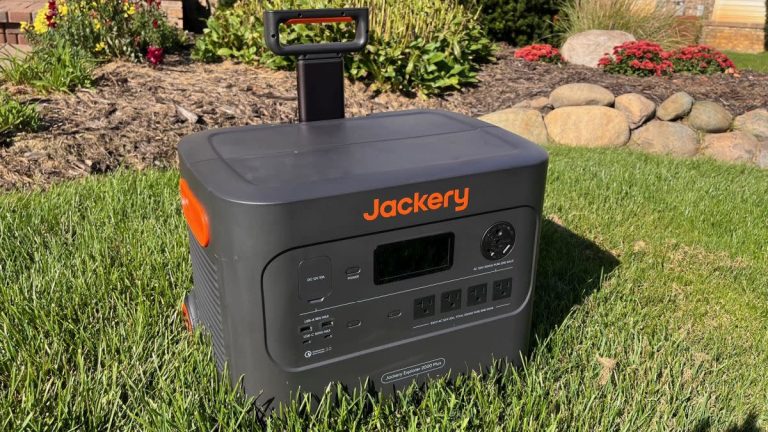
At first glance you could easily mistake the Jackery Explorer 2000 Plus for a beverage cooler, what with its distinctive shape, telescoping handle and convenient rear wheels. No beer in here, though, just a massive battery and even more massive power inverter, one that can crank out a whopping 3,000 watts — more than any other power station in the group.
The Explorer is also one of the most expandable products here, supporting up to five external batteries for a whopping 12,000Wh. You can even link a second Explorer, with five extra batteries of its own, and bring your available power output to 6,000W and capacity to over 24,000Wh — while also adding 240V support for the likes of clothes dryers and well pumps. That’s a lot of juice, enough to run an entire house. (That said, the total cost of such a setup — in the neighborhood of $20K — might require you to remortgage it.)
Back to the power station itself: It has ample AC and DC ports, plus a 25-amp circular AC outlet for use with RVs and various appliances. Unfortunately there’s no Qi charging pad up top, despite there being ample room.
Jackery’s SolarSaga 200 panels are a bit easier than most to set up thanks to a simplified weather-resistant cable that connects to the Explorer. However, although it’s less hassle than the multi-connector cords employed by most panels, it’s also proprietary, meaning it limits your ability to go third-party if you’re looking for cheaper options.
The Jackery app is useful for basic monitoring and enabling settings like battery saver and quiet charging, but it proved a bit flaky, often failing to accurately reflect what was happening on the device. When I manually powered on both the AC and DC outlets, for instance, the app showed only the latter as active. Later, after returning to the home screen, the device showed 0% power remaining, even though it was still fully charged. Hopefully Jackery will address these bugs in either a firmware or app update.
Although it’s priced roughly the same as the power stations from Anker and EcoFlow, the Jackery Explorer 2000 Plus edges out both thanks to higher output power and greater expandability. If those features rank high for you, this is the power station to pick.
Battery type: LiFePO4 | Capacity: 288Wh | Output power: 300W | Weight: 8.3 pounds | AC outlets: 1 | USB ports: 3 | Expandable: No | Solar panel tested: 40W (adds $100)
About as small and lightweight as these things come, the Explorer 300 Plus moves easily from one room to another — great for those times when it’s inconvenient to stay tethered to a big, heavy power station. Weighing in at just over 8 pounds and equipped with a convenient folding handle, Jackery’s little lunchbox goes wherever you need it to.
Of course, a small form factor means limited space for ports. The Explorer has just three USB ports (only one of them Type-A), one AC outlet and one 12-volt DC port. You could potentially charge the unit via your car’s power port (via USB-C), but Jackery doesn’t supply the necessary cable. The good news is that it’s very quiet while charging or operating, even when its fan kicks on.
I tested another charging option, Jackery’s optional SolarSaga 40W folding solar panel, which has a magnetic clasp that makes it easy to store and tote. The company estimates 7.5 hours to fully recharge the 300 Plus using sun alone, but of course that’s based on having 7.5 hours of unobstructed light and optimal positioning the entire time. Unfortunately, there’s no stand or any other means of propping up the panels. I tried leaning them against the power station itself but couldn’t get them to stay fully extended and or angle toward the sun. For what it’s worth, the larger SolarSaga 100W panels ($250) have a built-in kickstand, much like others I tested.
There’s a Jackery app that can connect to the power station for status monitoring and customization, but both an Android phone and an iPhone produced error messages in the final step of the pairing process. I checked Jackery’s support site for help, but at this writing there was no information whatsoever pertaining to the Explorer 300 Plus. For the record, the same phones had no trouble pairing with the Jackery 2000 Plus, so I suspect my review sample was defective in this respect.
Although you lose some versatility with a smaller power station like this, it’s worth considering if you want something that’s easy to move from room to room and suitable for powering small devices.
Battery type: LiFePO4 | Capacity: 403Wh | Output power: 600W | Weight: 20 pounds | AC outlets: 2 | USB ports: 3 | Expandable: Yes | Solar panel tested: No
As a general rule, water and electricity don’t mix well. But splashes and such aren’t a problem for Bluetti’s AC60, which is IP65-rated against dust and water and comes with every port covered by a removable rubber cap. If it gets caught out in the rain or snow, a quick towel-dry gets you back in business.
That’s one of the AC60’s major benefits; the other is expandability. You can connect up to two Bluetti B80 external batteries, each supplying an extra 806Wh of capacity (for a maximum total of just over 2,000Wh). This option lets you keep your up-front cost on the lower side but not lock yourself into the capacity afforded by the main unit.
Speaking of which, the AC60 offers a modest 403Wh on its own. But its output power is impressive: up to 600 watts (or 1,200 in “Power Lifting” mode), enough to run something as substantial as a refrigerator (though not for very long). Meanwhile, it weighs a very manageable 20 pounds and carries easily thanks to its folding handle.
I tested the AC60 with one B80 expansion battery. The former stays almost silent while charging, but when you plug in a B80, its fans kick on and definitely make some noise. It’s unfortunate that the B80 lacks a dedicated AC charging input; you have to connect it to the main unit, or use something like solar panels or a car port if you want to charge on its own.
You can, however, use a B80 on its own; each one has a high-output USB-C and USB Type-A port, plus a 12V car outlet. I like that added versatility; not many power-station expansion batteries support this kind of stand-alone use.
I’m a little disappointed, though, by the sizable rear flashlight, which has only two brightness settings and just isn’t very bright overall. Deeno’s S1500, in comparison, features a similar LED panel that produces considerably more light.
Bluetti’s companion app pairs easily via Bluetooth and provides useful status information, controls and so on. It also provides quick access to customer support, user forums, warranty information and more.
Whether you’re concerned about water or dust mucking up the power-station works, or you want a portable system that can grow as your needs do, the Bluetti AC60 is a top pick.
Pros
Fast AC recharging
IP65 water-resistant
Covered ports
Useful companion app
Qi charging pad for phones
Supports up to 2 expansion batteries
Cons
On the heavy side
Limited main-unit capacity
Expansion batteries require main unit for AC charging
Battery type: Li-ion | Capacity: 648Wh | Output power: 600W | Weight: 15.4 pounds | AC outlets: 2 | USB ports: 4 | Expandable: Sort of | Solar panel tested: No
Most power stations suffer from a key problem: When the power runs dry, you have to wait for it to recharge — if you even have the means to do so. Runhood’s 600 employs swappable batteries, an effective solution and an interesting alternative to dealing with solar panels (though you can easily add those to the mix).
The unit resembles an oversize orange lunchbox, with a carrying handle built into the top and an LED flashlight facing front, just above the control panel. It’s a good design overall, and I like how many outputs Runhood managed to squeeze into this thing. Just one gripe: The stacked AC outlets limit you to just one three-prong plug (the other must be two-prong).
With both batteries installed, the Rallye 600 weighs a manageable 15 pounds. Batteries slide into separated compartments inside the main unit (referred to as the “Host Engine”) and slide out again with ease by pushing a release button. The AC adapter will charge those batteries while they’re inside, as will an included car-port charging cable.
To recharge a battery outside the Host Engine, you’ll need Runhood’s UE256 adapter, which is included with select bundles or available separately. It’s basically a USB port replicator that snaps onto the battery, effectively turning it into a smaller, more portable power bank — but also allowing for external recharging via USB-C. Runhood’s optional solar panels can also recharge a battery outside the Host Engine.
Thus, in something like a camping or power-outage situation, you could swap additional batteries into the Host Engine as needed, charging depleted ones via solar without having to schlep the entire unit outside.
And that’s really the secret sauce here. While something like the Bluetti AC60 can be expanded by way of an external battery pack, the Runhood Rallye 600 affords a more compact and mobile-friendly solution.
Pros
Lots of outputs
Supports hot-swappable replacement batteries
Cons
Only one AC outlet is 3-prong
Using batteries outside unit requires optional adapter
If you’re looking for a power station that charges quickly, serves up an abundance of outlets and pairs with an easy-to-use mobile app, the EcoFlow Delta 2 Max answers the call. It can also accommodate up to two external batteries for even more capacity. Without those benefits, it might be harder to overlook some of the usability frustrations I encountered in my testing.
This 50-pounder is lighter than the Anker and Jackery models, which is good because it lacks wheels. But even with the two sturdy built-in handles, it requires considerable muscle to move around. What’s more, because the handles protrude to the sides instead of up, it’s more difficult to see the status screen that’s embedded in one end. That screen is plenty bright, but you either have to crouch down or tip the unit awkwardly.
Also awkward: EcoFlow put the AC outlets and 12-volt port on one end and the USB ports on the other. Expansion-battery ports live on the side. I can’t say I see any advantage to this design; indeed, it’s annoying having to check both ends to find what I want, especially on a heavy, wheel-less unit. Nearly all other power stations arrange everything front-and-center, which I find far more convenient.
EcoFlow’s 220-watt solar kit is interesting in that the four folding panels are bifacial, aka double-sided, which could potentially result in more sun absorption and higher input wattage. But the execution is strange: The carrying case doubles as a stand for the panels, but it’s not super obvious how it works, and the printed quick-start guide offers little help. You need to clip four included carabiners (all made of flimsy plastic) to both the stand and the panels. If you want to change the angle to better meet the sun, you partially zip the case closed to make it stand up straighter. I have concerns about the long-term durability of this design; zippers are notoriously troublesome, and the clips seem likely to break.
Because the Delta 2 Max relies on standard connectors, you could potentially choose different panels. In the end I found EcoFlow’s to be heavy, cumbersome and an overall pain.
Lest I sound too harsh about this power station, I’ll borrow Han Solo’s description of the Millennium Falcon: She’s got it where it counts. There’s plenty of power on board, room for more outboard and a useful companion app to let you monitor and tweak things. I just don’t love some of EcoFlow’s design decisions, especially with regard to the solar panels.
Pros
Fast charging
Lots of outputs
Bright status screen
Excellent companion app
Double-sided solar panels
Cons
Ports inconveniently spread out across three sides
The Solix F2000 (also known as the PowerHouse 767) is a heavyweight in every sense of the word, starting with actual weight: It’s 67 pounds on its own, and if you tack on the massive 400-watt solar panel array, that’s another 35. Thankfully, in addition to a pair of carrying handles to help you lift this monster, it has wheels and a completely hidden telescoping handle that extends from the front. It’s a clever design, though that handle could get in the way if you’re trying to wheel the unit into a tight space.
Like the Jackery Explorer, the F2000 serves up four standard AC outlets and a TT-30R outlet for use with RVs, though the latter’s amp output isn’t specified anywhere. Is it 20 amps like the other outlets, 25 like on the Jackery or 30 because it’s a “TT-30”? Unfortunately, Anker chose not to label any of the ports — AC, DC, USB or otherwise — with power output numbers. It’s a small thing but definitely inconvenient if you want to make sure any given outlet has the power you need.
I also found myself wishing for a Qi charging pad up top, but you’ll have to use a cord to charge your phone.
If you end up needing more than the 2,048Wh the F2000 provides out of the box, you can double it by adding a second battery — but only one, which is a bit limiting. EcoFlow’s power station can accommodate two, while Jackery’s Explorer supports up to five.
Anker’s HyperFlash technology promises an 80% recharge in under 90 minutes (using AC power), which is extremely impressive. And the company’s solar array brings in almost double the charge of others I tested, but it’s large, heavy and cumbersome — difficult for one person to set up and difficult to reorient toward the sun throughout the day. If you live on your own, you could opt for a pair of 200-watt panels instead.
The nicely polished Anker app shows not only power remaining but also the consumption for each individual port, not just AC or DC on the whole. From the main screen you can quickly toggle power-saving mode on or off and choose from any of the three flashlight brightness settings. (The LED strip is pretty dim overall, though — useful for seeing what you’re doing with plugs and such but hardly a camp light.) Take note that the app relies on Bluetooth connectivity; it doesn’t do Wi-Fi, so your phone needs to be in close proximity.
Although it’s not the most expandable power station in the group, the Solix F2000 provides ample power for lots of devices, large and small.
Battery type: LiFePO4 | Capacity: 1,036Wh | Output power: 1,500W | Weight: 31 pounds | AC outlets: 3 | USB ports: 5 | Expandable: No | Solar panel tested: 200W (add $400)
To borrow a car analogy, the Deeno GT S1500 is the efficient midsize sedan in this roundup, combining a solid selection of ports with some muscle under the hood. It’s comparatively affordable and, er, easy to fit in the garage. (Even its name is car-like!)
Although it weighs only about 30 pounds, the S1500 delivers an impressive 1,500 watts of output power. I like the large, easy-to-read status screen that’s flanked by all available AC, DC and USB ports. There’s also a 15-watt Qi pad up top, awesome for phone charging.
I can’t say I fully understand the handle design, though: The two corner grips telescope up about 2 inches when you lift the S1500, to no discernible advantage. I guess if you’re wearing heavy gloves, now you have more room to slip your hands in. But if the handles didn’t move the way they do, the unit wouldn’t be any easier or harder to carry.
There’s a large LED panel on the rear of the station with three light levels (the highest being quite bright), and it can also produce an SOS flash.
Deeno promises a full recharge (via AC power) in just two hours, a number my informal testing bears out. (In fact, I went from 23% to full in just one hour, so it would appear to be even faster than Deeno’s claim.) There’s an included car adapter for recharging while driving, but that takes roughly three times as long.
As for solar, the optional 200W solar panel array (which is a bit less expensive than most) includes three separate kickstands and a convenient zippered compartment that holds the permanently affixed charging cables. When paired with the solar cables included with the S1500 itself, you get a run of nearly 20 feet — very handy if your solar setup needs to have some distance from the station.
Do I wish Deeno offered a companion app for monitoring, settings and all that? Sure. Would I let that stop me from choosing this “midsize sedan”? Definitely not. Deeno may not be a household name, but the S1500 is a superb portable power station.
Not to be confused with mobile chargers, those little pocket-size batteries many people carry while traveling, power stations employ larger, heavier cells designed to run more and larger devices. Depending on how much capacity it has, we’re talking anything from a laptop or fan to a space heater or refrigerator. Shoot the works and you might be able to power your entire home — or at least most of the major appliances.
The 7 power stations tested in this story. (Rick Broida/Yahoo News)
This stuff can be confusing, though. You’re going to see a lot of numbers pertaining to things like watts and volts, a lot of terms like “peak power” and “LiFePO4” and prices ranging from around $300 on up into the thousands. For purposes of this roundup, we’re focusing less on the techie aspects of this gear and more on the real-world applications: keeping your devices and appliances powered during a power-outage situation and finding the best bang for the buck in terms of capacity, number of ports and ease of use.
Whenever possible we tested solar panels as well, because the sun might be your only lifeline in an extended-outage situation. Just be prepared for some added expense, because these panels can add hundreds of dollars to the cost of your setup. (Good news, though: They may qualify for tax rebates.) They’re also a far cry from a standard AC outlet in terms of power supply; it takes far longer to recharge a power station via solar than it does via a wall plug. (See below regarding the promise of solar versus the reality.)
Before we dive into the stations themselves, let’s review some of the important features and options:
Battery capacity: This is the big one. More capacity equals more juice for your stuff. (Think of it as the, er, gas tank.) It also equals a higher price, more weight and usually more ports, features, etc. The challenge here is determining how much capacity you need, especially because there are different metrics used to identify it: mAh (milliamp hour), Wh (watt hour), kWh (killowatt hour) and so on. Some power stations are also expandable, meaning you can connect supplemental batteries to expand the overall capacity. Bottom line: Buy the highest-capacity power station you can afford, ideally one that’s expandable, while also keeping in mind the next item:
Size and weight: This should come as no surprise: The larger the battery capacity, the larger and heavier the power station will be. So-called lunchbox models — named for their shape and integrated handles — might weigh anywhere from 5 pounds on up to 20, which makes them relatively easy to tote where needed. But a big power station like the Anker Solix F2000 can tip the scales at nearly 70 pounds — not to mention any supplemental batteries you’ve added. If you’re planning on something like that to take up semi-permanent residence, it might behoove you to also purchase a smaller, lighter model that can move around. Also, look for wheels and a luggage-style telescoping handle, which makes relocating the big batteries much easier.
Battery type: More power-station makers are switching to lithium iron phosphate (aka LiFePo4) batteries, which are known to be safer for home use than their lithium-ion counterparts. They also charge faster and have much longer lifespans, by most estimates anywhere from 3 to 5 times longer. That means a better return on your investment, even if you pay a little more up front.
The Deeno GT power station has front-facing ports and an informative display — but no companion app. (Rick Broida/Yahoo News)
Total output power: Different devices and appliances consume different amounts of power. A mini-fridge, for example, might use around 45 watts, while a full-size one might need more like 500. A simple space heater: 1,500 watts. A laptop: 90 watts. A CPAP machine: 30 to 60 watts. Consider numbers like those when evaluating a power station’s total output power. A 300-watt model has a much more limited scope than one capable of 2,000 watts. (But it’s also cheaper and lighter — so, you know, trade-offs.)
Number and type of ports: What do you need to plug in? Most power stations have at least one AC outlet and multiple USB ports. You might also find things like a 12-volt car socket (which used to be called a cigarette lighter), a DC5521 port, a TT-30 outlet (sometimes known as an RV30) and possibly even a Qi charging pad for phones and other devices. Needless to say, more ports and outlets give you more flexibility. Take note, however, that some power stations do a better job than others at labeling; in a few cases it’s not clear exactly what’s what.
Display size and readability: Most of the power stations here employ an LCD status display, showing remaining battery life, input and output measurements, and so on. Readability is usually quite good indoors, but some are harder to see outside, especially under bright sun. And because they’re almost always mounted on one side of the power station, you usually have to tilt the unit up or squat down to see it. That’s why I’m partial to models that have companion apps, which let you monitor everything from your phone and, in some cases, enable or disable ports, tweak settings and so on.
If you’re a total novice when it comes to power stations, look for a model with decent printed instructions. (Rick Broida/Yahoo News)
Printed instructions: Even I get confused by tech sometimes, and power stations can be a little intimidating — especially when it comes to things like solar panels. Unfortunately, not all companies bother to supply decent instruction manuals, even with products costing $1,000 or more. Below, I’ve shouted out the ones that are particularly good — or particularly bad.
3 important things to know about power stations
While I wish I could say that big batteries are the ideal alternative to gas generators, there are three caveats I think you should know.
Power stations aren’t “generators,” at least in the traditional sense. Although some manufacturers use that terminology in their product descriptions, these are not machines that convert mechanical energy into electricity. They’re rechargeable batteries, ones that can themselves be recharged via electricity. Now, if you add solar panels to the mix, you can more accurately describe the setup as a generator, because the sun is indeed generating power. But as you’ll see in the next item, solar doesn’t always pay the rent.
The promise of solar charging is different from the reality of solar charging. In my testing, the various panels rarely produced anywhere near their rated maximum watts — and that means sun-powered charging may take longer than expected. The panels included with Jackery’s Solar Generator 300 Plus, for example, promise up to 40 watts, but when I placed them under direct sun, I never saw the input number climb above 25. On a slightly hazy day, it typically ran around 16 to 17 watts. Anker’s mammoth 400-watt array, meanwhile, rarely went above 270. Deeno’s 220-watt panel topped out around 150 watts. Yes, there are lots of variables that affect solar charging — and that’s the problem. Even under the most optimal conditions — clear skies all day, perfect panel positioning, unobstructed exposure throughout that day — you’d need a lot of hours to fully recharge a power station on solar alone.
Whole-home setups aren’t really here yet. When I started working on this story, my hope was to equip my modest-sized suburban home with an off-the-shelf battery backup system that would live in the basement and keep the lights on during a power outage. Unfortunately, even if I invested thousands of dollars, I wouldn’t get the output power or capacity needed to run the whole house. I learned I could offload certain circuits (furnace, well pump, refrigerator, etc.) to a secondary breaker box, then set up a transfer switch to manually flip when needed, but even then I might get only one or two days’ worth of power. (Better than nothing, to be sure.) And these folding, portable solar panels aren’t really intended for permanent installation; they’d have to be hauled out and set up whenever needed.
One more thought on the whole-home plan: Here in Michigan, I had a hard time finding an electrician who was experienced with this kind of thing. More than a few declined to provide an installation estimate because they weren’t familiar with the equipment.
Companion apps can be helpful for monitoring power-station status, adjusting settings and more. (Rick Broida/Yahoo News)
Make no mistake, systems like this are almost certainly the future, and they can be extremely useful as they are right now. If you live someplace where a gas generator isn’t practical or desirable, they’re an excellent option. But it might be another year or two before you can flip a switch and let a battery do the heavy lifting for your whole house.
CNBC’s Julia Boorstin uses AI tools to plan her vacation to Hawaii and shares details on how major tech companies are entering the AI travel planning space.