


Michelle Meyer, Mastercard Economics Institute chief economist, joins ‘Power Lunch’ to discuss the state of the travel economy, how its changing and much more.
04:30
Tue, May 12 20262:48 PM EDT
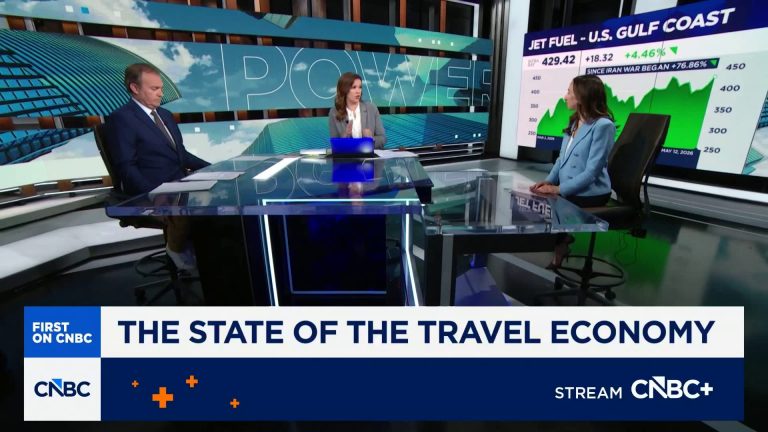
Michelle Meyer, Mastercard Economics Institute chief economist, joins ‘Power Lunch’ to discuss the state of the travel economy, how its changing and much more.
04:30
Tue, May 12 20262:48 PM EDT


A United Airlines plane approaches the runway at Denver International Airport on March 23, 2026.
Al Drago | Getty Images
United Airlines flight attendants approved a new five-year labor contract with 31% average raises to base pay by August and other improvements, marking the last of the major carriers with unionized flight crews to reach a deal post-Covid.
The labor deal would give United’s roughly 30,000 flight attendants their first raises in close to six years. The company and the flight attendants’ union reached a preliminary deal in March. Crews had rejected a contract last year.
The union said the contract won 82% approval from the flight attendants, with close to 90% of them voting.
“The contract will immediately change the lives of United Flight Attendants, especially our thousands of new hires who have been hired since the pandemic,” said Ken Diaz, president of the United chapter of the Association of Flight Attendants.
The contract also includes boarding pay, or pay for when the aircraft’s door is open and travelers are getting on. Airlines had for years started flight attendants’ pay clock once the boarding door was closed.
The contract comes with a roughly 7% to 8% increase in compensation and $741 million in back pay, as well as quality-of-life improvements like restrictions on red-eye flights and “sit pay” during disruptions of more than 2½ hours.

 |
TOKYO, May 12, 2026 /PRNewswire/ — SwitchBot, a leading provider of AI-enabled embodied home robotics systems, today announced the launch of KATA Friends, Noa and Niko, a new series of AI Pets designed to bring companionship, emotional connection, and intelligent interaction into everyday life.

SwitchBot KATA Friends
Unlike traditional smart devices focused on utility, KATA Friends are designed as companions that live alongside users, learning, responding, and growing over time. By combining AI with expressive design and physical interaction, KATA Friends introduce a new category of home robotics centered on presence and connection.
A Companion That Feels Alive
KATA Friends are designed to feel less like machines and more like living companions. Each one comes with its own personality and evolves based on how users interact with it, ensuring that no two KATA Friends are ever the same.
With expressive eyes, natural movements, and 12 touch-sensitive zones across its body, KATA Friends react intuitively to hugs, gestures, and everyday interaction. They can move independently around the home, avoid obstacles, and return to their charging base on their own, reinforcing a sense of autonomy and lifelike behavior.
Understands You and Adapts to Your Life
Designed to integrate naturally into daily routines, KATA Friends respond to voice commands, gestures, and behavioral cues. Users can call them over, interact through simple gestures, or communicate using everyday language, creating an experience that feels intuitive and engaging.
Beyond direct interaction, KATA Friends observe and respond to user behavior. They can greet users in the morning, wait by the door when someone is about to arrive, or quietly offer companionship during moments of rest. Through voice emotion recognition, they can also sense changes in mood and respond accordingly, adding an emotional layer to everyday interaction.
A Personalized Companion That Grows Over Time
KATA Friends are designed to build long-term relationships with users. They can recognize different members of a household and respond uniquely to each individual, remembering preferences and interaction patterns over time.
As users spend more time with their KATA Friend, it develops its own behavior and attachment patterns, shaped entirely by how it is “raised.” It can also document shared experiences by keeping a diary of daily interactions and capturing photos from its own perspective, allowing users to revisit moments through the eyes of their companion.
In addition, KATA Friends offer customization options, including interchangeable outfits and accessories, allowing users to personalize both appearance and personality.
Powered by AI for Real-Time Interaction
KATA Friends are equipped with cameras, sensors, and AI capabilities, enabling them to process interactions locally and respond in real time.
The on-device LLM allows KATA Friends to understand speech without relying on constant connectivity, while local visual data processing capabilities enable KATA Friends with gesture comprehension and facial recognition, ensuring responsive interaction and enhanced privacy. Meanwhile, with the Chat Mode, KATA Friends can conduct conversations with users for even more authentic and immersive interactions.
Expanding the Role of AI in Everyday Life
With KATA Friends, SwitchBot expands its vision of embodied AI beyond convenience and automation into companionship. By focusing on interaction, personalization, and emotional intelligence, KATA Friends introduce a new way for users to engage with AI, one that is more human-centered, intuitive, and meaningful.
Pricing and Availability
KATA Friends will be available through the official SwitchBot website, with an MSRP starting at USD 699.99 / GBP 599.99 / EUR 599.99 / CAD 999.99.
For more information, please visit SwitchBot’s official website and follow SwitchBot on X, Instagram, Facebook, and YouTube.
Media Kit: SwitchBot KATA Friends

NEWYou can now listen to Fox News articles!
Researchers recently recovered 42 lost pages from Codex H, one of the world’s most important early New Testament manuscripts.
Codex H, short for Codex Hierosolymitanus, is a palimpsest — meaning parts of the manuscript were reused and rewritten over the centuries.
Researchers were tipped off after discovering the manuscript had been re-inked, leaving faint mirror-image traces of the original text.
RARE MEDIEVAL BIBLE RETURNS TO ISRAEL FOR PUBLIC EXHIBIT AFTER CENTURIES-LONG JOURNEY
Then they used modern technology, including multispectral imaging, to recover “ghost” text that isn’t visible to the human eye.
The discovery was announced by the University of Glasgow in an April 24 press release.
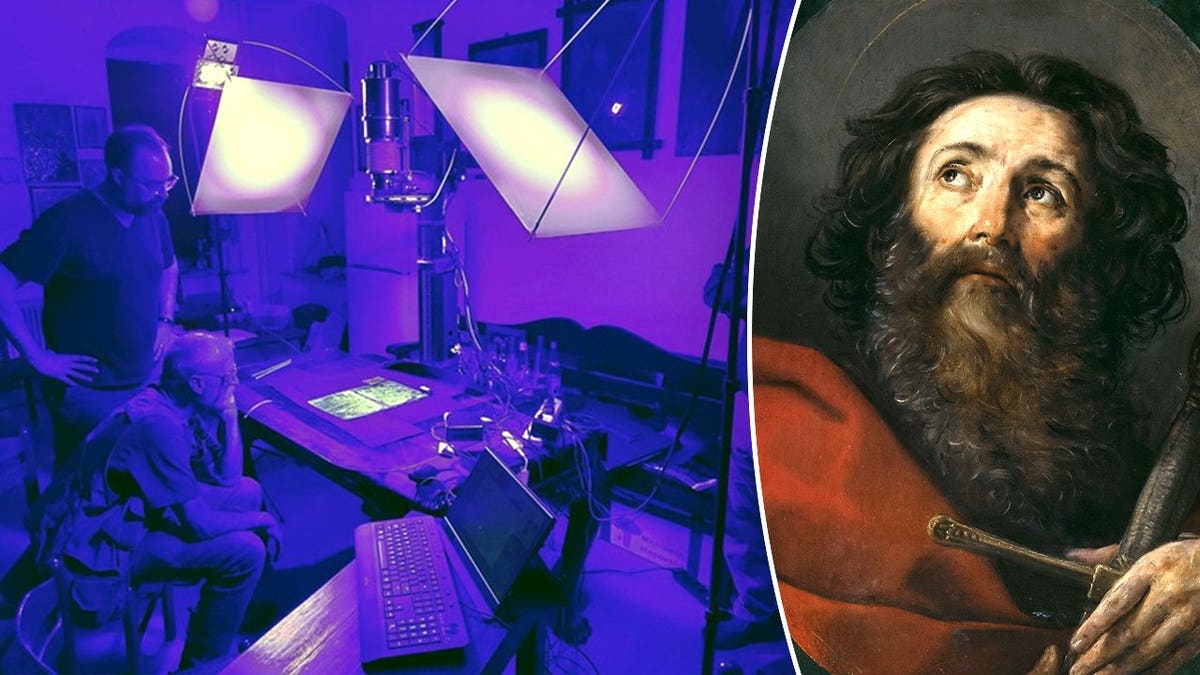
Researchers have recovered 42 previously lost pages from Codex H, an early New Testament manuscript that contains a copy of the Letters of St. Paul. (Damianos Kasotakis; Fine Art Images/Heritage Images via Getty Images)
“The fragments show how 6th-century scribes corrected, annotated and interacted with sacred texts,” the university noted in its release, with the physical state of the manuscript revealing “how sacred works were reused and repurposed once they fell into disrepair.”
The text, which does not contain any new scripture, dates back to the sixth century and is a copy of the Letters of St. Paul.
It was disassembled in the 13th century at the Megisti Lavra monastery on Mount Athos, Greece.
‘UNEXPECTED’ ROMAN-ERA DISCOVERIES UNEARTHED IN BIBLICAL CITY MENTIONED IN BOOK OF REVELATION
Since then, its pages have been scattered across libraries in Europe, with only fragments of the original manuscript surviving, including some held by the University of Glasgow.
It was within these fragments that a team of researchers identified the lost pages, including ancient chapter lists, which “differ drastically from how we divide these letters today,” the university said.

The text was originally disassembled in the 13th century at a monastery on Mount Athos in Greece. (Damianos Kasotakis)
Codex H’s significance stems in part from its rarity, said Garrick Allen, a University of Glasgow professor who led the project.
“It’s an important witness to the text of Paul’s Letters in a period where we don’t have that many manuscripts,” the professor told Fox News Digital, referring to the sixth to ninth centuries.
ANCIENT CHRISTIAN MONASTERY COMPLEX REVEALS LIVES OF BYZANTINE MONKS BEFORE ARAB CONQUEST
The practice of marking up biblical texts dates back centuries, much as readers still do today — and Codex H preserves over 1,000 years of annotations.
“Manuscripts of the New Testament and other literature were often annotated and marked up by scribes and readers,” Allen noted.
“We have recovered [these pages] due to the unintended results of a medieval conservationist.”
Codex H, for example, includes “over 70 corrections to the text itself by a scribe who compared its text against another manuscript,” the professor said.
The manuscript also contains “many annotations by at least 15 later readers who left their marks through prayers, poems, grammatical notes and other information.”
CLICK HERE TO SIGN UP FOR OUR LIFESTYLE NEWSLETTER
“These types of notes are not unusual but, because Codex H had such a long life in many forms, its pages attracted many interested readers — and these annotations are often the only tangible evidence left that these anonymous people existed,” said Allen.
As for why the manuscript was disassembled, Allen suggested it likely “reached the end of its working life.”
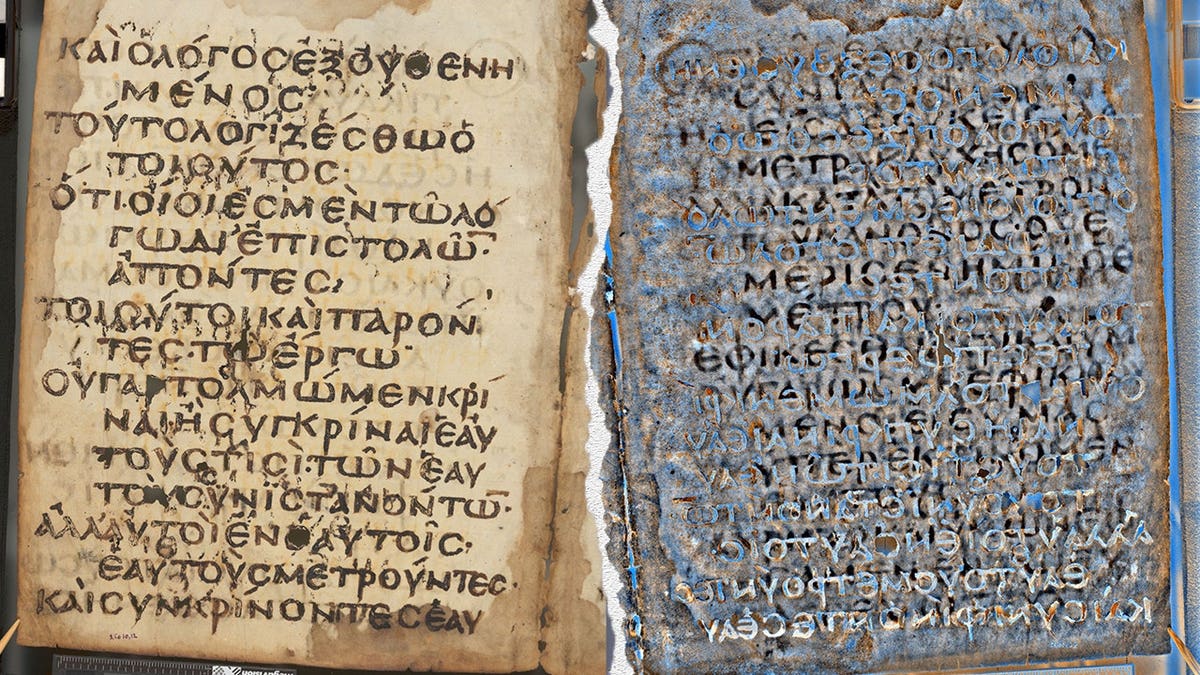
The recovered pages from Codex H offer new insight into how the Letters of St. Paul were copied and studied. (Early Manuscripts Electronic Library, Monastery of Great Lavra)
“Six hundred to 700 years is a long time for a book to be kept in working order, even though we know that at least one person attempted to conserve it during this period through re-copying,” he said.
“In a remote location like Mount Athos in a period where parchment was very expensive to produce, it makes sense that the monastery reused this manuscript to keep up other books in their library.”
CLICK HERE FOR MORE LIFESTYLE STORIES
Ironically, breaking the manuscript apart helped preserve it, Allen noted — its pages were reused inside other books and eventually spread across European collections.
“The book was re-inked in its entirety at some point in its working life, meaning that someone rewrote over the existing text … in an attempt to keep the book usable for a new generation,” said Allen.
“This process makes me optimistic that many ancient manuscripts still have much more to tell us about the people who made and used them.”
“Eventually, the book was disbound and reused as binding material and flyleaves when librarians at the Megisti Lavra monastery on Mount Athos repaired other books in their collection. It’s this repurposing of this ancient book that led to its continued existence.”
The most surprising part of the discovery, Allen said, was the sense of awe in reading biblical texts that “no longer exist.”

The discovery reveals new details about how early Christian scribes copied and corrected the Letters of St. Paul. (Damianos Kasotakis; Leemage/Corbis via Getty Images)
“We have recovered [these pages] only due to the unintended results of a medieval conservationist,” the expert said.
“This process makes me optimistic that many ancient manuscripts still have much more to tell us about the people who made and used them.”
That progress is being driven in part by advances in imaging technology, Allen added.
TEST YOURSELF WITH OUR LATEST LIFESTYLE QUIZ
“Although each manuscript is by definition unique and presents its own challenges, we think that we’ve developed a model for working with challenging manuscripts like palimpsests at a larger scale,” he said.
CLICK HERE TO DOWNLOAD THE FOX NEWS APP
“When manuscript and biblical scholars work closely with imaging specialists, data scientists, monastic communities, museums, and other local partners, we can really make progress in our understanding of these important documents.”

In a budget dominated by cost-of-living pressures and global instability, the Federal Government has unveiled a major multi-billion-dollar investment into Australia’s healthcare system.
Medicare Urgent Care Clinics, cheaper medicines and aged care reforms are at the centre of the package unveiled on Tuesday night.
The government has also invested into the aged care sector and still provided $1.7 billion to the NDIS despite significant efforts to tackle fraud in a bid to save $37.8 billion over the forward estimates.
Know the news with the 7NEWS app: Download today
So, what has been announced, and what does it mean for you?
The centrepiece of the health package is a $1.8 billion expansion of Medicare Urgent Care Clinics, aimed at reducing pressure on overcrowded emergency departments and improving access to bulk-billed care.
The budget also includes $2.1 billion over five years to improve access to primary and specialist healthcare services, including expanded bulk billing support.
“Medicare Urgent Care Clinics reduce out of pocket costs, because more bulk billing means less pressure on household budgets and emergency departments,” Treasurer Jim Chalmers said in his budget speech.
“By July, four in five Australians will live within a 20-minute drive of one of the 137 clinics around the country.
“We’re permanently funding every one of them with $1.8 billion over the next four years and about half a billion dollars every year after that.”

The government says the investment is designed to ease pressure on emergency departments while improving access to free urgent treatment for non-life-threatening conditions.
Support will also be delivered for six fully bulk-billed practices across the Central Coast, Newcastle, Lake Macquarie and Hunter regions, alongside continued support for endometriosis and pelvic pain clinics helping women experiencing endometriosis, pelvic pain, perimenopause and menopause.
The budget also delivers an additional $25 billion in Commonwealth funding for public hospitals over five years.
Several new medications will be added to the Pharmaceutical Benefits Scheme (PBS) and Repatriation Pharmaceutical Benefits Scheme, supporting Australians living with serious and chronic conditions.
The additions cover treatments for juvenile arthritis, multiple sclerosis, prostate cancer, lymphoma, lung cancer, bladder cancer, cerebral palsy and severe COVID-19.
Chalmers said changes to cystic fibrosis medication listings “will save some Australians around $250,000 a year”.
Among the medications being added are Humira for juvenile idiopathic arthritis, Briumvi for relapsing-remitting multiple sclerosis, Paxlovid for Australians at risk of severe COVID-19, and Opdivo and Yervoy for advanced or metastatic cancers.
The government has committed major new funding towards aged care, as Australia’s ageing population continues placing pressure on the sector.
A $565.1 million investment over four years will strengthen regulation, governance, workforce support and quality standards across aged care services.
Funding will also support aged care ICT systems, My Aged Care and the Aged Care Quality and Safety Commission, while boosting food quality and lifestyle support for older Australians living in residential care.

Another $606.5 million over four years will go towards increasing residential aged care bed supply and improving access for supported residents.
The National Disability Insurance Scheme will receive an additional $1.7 billion over five years to support participants and improve the quality and integrity of services delivered through the scheme.
The government will also introduce a new enrolment and digital payment system designed to improve payment integrity and reduce fraud and non-compliant payments.
The Fraud Fusion Taskforce will receive a further $280.1 million to continue investigating fraud and improper claims.
Despite the funding injection, the government is also expected to recoup $36.2 billion by curbing the scheme’s growth over the next four years.

“A big part of our savings package will restore the NDIS to its original intent and secure its future, so it grows in a sustainable way in line with programs like Medicare,” Chalmers said.
The budget papers reveal changes to limit who can access the NDIS and will reduce participant payments by at least $37.8 billion until 2030.
The budget also includes $13.1 million over three years to improve understanding of stillbirths, support grieving families and help prevent future stillbirths.
Meanwhile, $2 billion will be invested into the new Thriving Kids program, supporting children aged eight and under living with developmental delay and autism, alongside their families and carers.
The package includes support for earlier identification of developmental delays and expanded health assessment programs for young children.
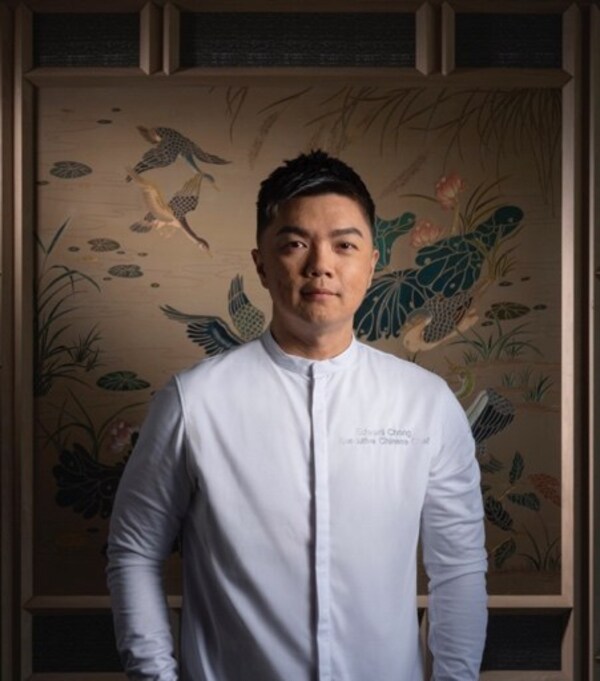
With its coveted One Diamond distinction, Peach Blossoms is proud to stand among just eighteen Singapore restaurants recognised in the Black Pearl Restaurant Guide, one of four in Singapore named on the Asia’s 50 Best Restaurants 2026 extended list, and among Tatler’s Best 20 Restaurants in Singapore for 2026.
SINGAPORE, May 12, 2026 /PRNewswire/ — Peach Blossoms has achieved a triple accolade in March and April 2026, earning a spot at No. 78 on the prestigious Asia’s 50 Best Restaurants Extended List, retaining its One Diamond rating in the Black Pearl Restaurant Guide, and being recognised yet again as a Tatler Best 20 Restaurant in Singapore for 2026. Together, these accolades mark a significant milestone in the restaurant’s rise on the regional and international culinary stage, affirming its growing influence in shaping modern Chinese cuisine in Asia.

Peach Blossoms Executive Chinese Chef Edward Chong
Helmed by Executive Chinese Chef Edward Chong, Peach Blossoms is one of the top Chinese restaurants in Singapore and has become synonymous with unique culinary interpretation, thoughtful storytelling and dishes shaped by Southeast Asia’s contemporary culinary sensibilities. Situated at PARKROYAL COLLECTION Marina Bay, Singapore, the restaurant presents a modern expression of Chinese cuisine that respects heritage while confidently embracing evolution.
Chef Edward Chong shares, “We are deeply honoured to once again be recognised by Asia’s 50 Best Restaurants, the Black Pearl Restaurant Guide and Tatler. Singapore has an incredible dining scene and we are proud to stand alongside some of the very best. While these awards affirm our team’s dedication to modern Chinese cuisine rooted in the region’s Southeast Asian heritage, our guests remain at the heart of all we do. Their support and satisfaction when they dine at Peach Blossoms inspires and motivates us as a team.”
Over the past year, Peach Blossoms has continued to strengthen its standing with a series of notable accolades, including:
Phil Smith, General Manager of PARKROYAL COLLECTION Marina Bay, Singapore, adds, “We are immensely proud of Peach Blossoms’ continued recognition among Asia’s most prestigious dining accolades. These achievements underscore our commitment to nurturing culinary talent that represents Singapore on the international stage. We congratulate Chef Edward and his team as they continue to raise the bar for modern Chinese dining and Peach Blossoms.”

Braised Mung Bean Noodles in Crab Roe Collagen, served with Crab Claw stuffed with Prawn Mousse
At Peach Blossoms, the menu balances precision and imagination. Signatures such as the Forbidden Roll, Braised Mung Bean Noodles in Crab Roe Collagen, and Crispy Scales Fillet of Marble Goby demonstrate the restaurant’s ability to elevate Chinese cuisine through new ingredients and techniques, while honouring its cultural roots.
As Peach Blossoms continues to evolve, this latest recognition signals not only sustained excellence, but a broader movement, positioning Singapore’s modern Chinese cuisine firmly within Asia’s most compelling culinary conversations.
RESTAURANT INFORMATION
Cuisine: Modern Chinese
Address: PARKROYAL COLLECTION Marina Bay, Singapore (Level 4)
6 Raffles Boulevard, Singapore 039594
Contact: +65 6845 1118 | peachblossoms.prsmb@parkroyalcollection.com
Click here to access Peach Blossoms’ website.
Click here to access Peach Blossoms’ press kit.
The view from the rooftop pool of the Marina Bay Sands resort hotel, which overlooks the financial district skyline of Singapore.
Anthony Wallace | Afp | Getty Images
Singapore, long viewed as a bellwether for the global economy, expects tourism spending to soften this year despite forecasting another increase in visitor arrivals, reflecting concerns that conflicts in the Middle East could weigh on consumer and business spending.
The Singapore Tourism Board projected tourism receipts of 31 billion and 32.5 billion Singapore dollars ($24 billion to $25.6 billion) in 2026, compared with a record of 32.8 billion Singapore dollars last year. International arrivals are forecast to rise to between 17 million and 18 million this year, from 16.9 million in 2025.
The city-state is a regional hub for business travel and airline stopovers and has hosted major events, including the Formula One Singapore Grand Prix and concerts by megastars Taylor Swift, Coldplay and Blackpink. Tourism accounted for 6% of Singapore’s services exports in 2024, according to the Singapore Tourism Board.
Despite visitor arrivals rising 3% in the first quarter from a year earlier, tourism spending is expected to soften because of “muted demands in the months ahead”, Melissa Ow, chief executive of Singapore’s Tourism Board, said at the country’s annual industry conference.
The caution from Singapore’s tourism authorities echoes broader concerns across the business travel industry. The Global Business Travel Association said geopolitical tensions and higher fuel costs were creating instability across international travel markets, even as Asia remained comparatively resilient.
Asia Pacific accounts for more than 40% of global business travel spending, according to the Global Business Travel Association.

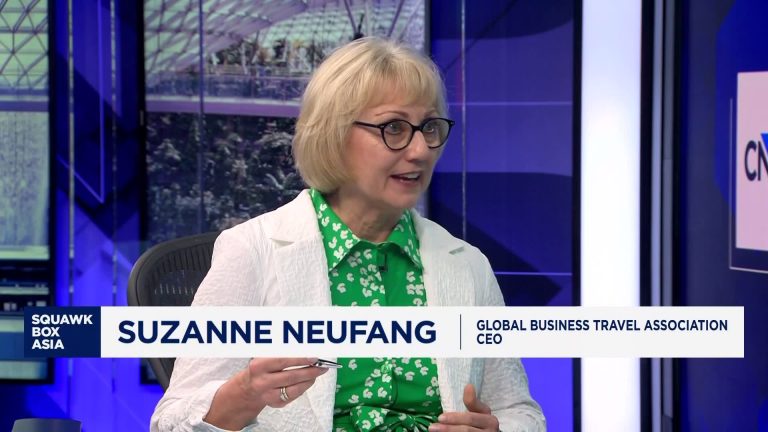
Suzanne Neufang, CEO of the Global Business Travel Association, told CNBC’s Monica Pitrelli that business travel globally has yet to fully recover to pre-pandemic levels, even as travel costs remain elevated.
While geopolitical or economic “wobbles” are inevitable, Singapore’s tourism strategy still has “one and a half decades to go,” Ow said.
Singapore’s “Tourism 2040″ strategy aims to increase tourism receipts to between 47 and 50 billion Singapore dollars by 2040.
In 2025, a record of 70 million passengers passed through Singapore’s Changi Airport.
“Uncertainty is not the travel industry’s friend,” Neufang told CNBC. However, meetings and conferences remain among the most resilient segments of the travel industry, she added.
South Korean boyband BTS’ planned four-night Singapore stop in December is also expected to support tourism demand. Ow said Singapore’s calendar has remained “very resilient” despite flight disruptions linked to tensions in the Middle East.
Singapore also announced a three-year partnership with South Korean drama production company Mr Romance. The first collaboration, “Buy King,” is being filmed in Singapore and stars South Korean actors Ju Ji-hoon and Lee Jun-ho.
Singapore Minister-in-charge of Trade Relations Grace Fu said at the event that the government would inject a fresh 740 million Singapore dollars into the Tourism Development Fund over the next five years, on top of more than 300 million Singapore dollars announced in 2024.
Another 5 million Singapore dollars will be set aside under a separate fund to help tourism businesses expand into new markets and reduce the financial risks of expansion, Fu said.
Singapore is also looking to attract more cruise tourists as disruptions to Middle East airspace and volatile jet fuel prices continue to weigh on air travel.
Disney Adventure, the largest ship in Disney’s cruise fleet and the company’s first vessel based outside the U.S., began operating from Singapore on March 3.
Singapore is also preparing to open a new cruise and ferry terminal on July 15. The site will feature a VIP lounge and an automated baggage handling system as the country looks to expand a cruise sector that recorded 375 ship calls and more than 2 million passengers in 2025.
Still, Ow said Singapore remained focused on its long-term tourism ambitions.
“Current times are highly uncertain and very volatile,” she said. “We’re choosing to be more conservative in terms of how we are expecting the year to turn out.”
— CNBC’s Monica Pitrelli contributed to this report.

 |
SINGAPORE and DUBLIN, May 11, 2026 /PRNewswire/ — Southeast Asia’s leading superapp, Grab, has partnered with Nuitée, an AI-first travel technology company, to launch GrabStays, a new travel accommodation booking service within the Grab app.
Powered by Nuitée’s global travel infrastructure, GrabStays is especially convenient for Grab users to make last-minute travel accommodation booking as it is integrated into the Grab superapp, thus making travel accommodation booking – both last-minute and planned – as easy as requesting a Grab ride.
Benefits of GrabStays
Under this exclusive partnership, Nuitée provides the underlying infrastructure supporting GrabStays, including the API-based integration that gives users access to Nuitée’s global hotel inventory. With GrabStays, users are offered competitive same-day rates from Nuitee’s global hotel inventory, and also benefit from earning loyalty points (GrabCoins) in the Grab’s ecosystem.
When using GrabStays, users can:
GrabStays is one the services launched under Grab’s Partner Apps programme, which makes products, services, and content from third-party partner brands directly available within the Grab app, complementing Grab’s core suite of on-demand offerings. Through Partner Apps, Grab is expanding the number and types of services available to users, while giving businesses the opportunity to reach Grab’s millions of monthly transacting users region-wide.
GrabStays will launch first in Singapore later this month, followed by other markets in 2026.
Paul-Eric Licari, Regional Head, Group Business Development at Grab, said: “Grab’s promise to be an intelligent everyday guide for millions in Southeast Asia doesn’t stop at one’s borders. With 200 million passengers moving through Southeast Asian airports annually, GrabStays is how we make the regional travel experience more frictionless. By bridging the gap between mobility, payments, and accommodation, we are creating a more rewarding journey for consumers and a powerful engine for our partners to scale their reach within our ecosystem.”
Med Benmansour, Founder and CEO of Nuitée, said: “This partnership demonstrates how travel can be delivered as infrastructure rather than a standalone product. By enabling embedded, programmable distribution, we support partners like Grab in integrating travel seamlessly into their existing ecosystems.”
About Grab
Grab is a leading superapp in Southeast Asia, operating across the deliveries, mobility and digital financial services sectors. Serving over 900 cities in eight Southeast Asian countries – Cambodia, Indonesia, Malaysia, Myanmar, the Philippines, Singapore, Thailand and Vietnam – Grab enables millions of people everyday to order food or groceries, send packages, hail a ride or taxi, pay for online purchases or access services such as lending and insurance, all through a single app. We operate supermarkets in Malaysia under Jaya Grocer and Everrise, which enables us to bring the convenience of on-demand grocery delivery to more consumers in the country. As part of our financial services offerings, we also provide digital banking services through GXS Bank in Singapore and GXBank in Malaysia. Grab was founded in 2012 with the mission to drive Southeast Asia forward by creating economic empowerment for everyone. Grab strives to serve a triple bottom line – we aim to simultaneously deliver financial performance for our shareholders and have a positive social impact, which includes economic empowerment for millions of people in the region, while mitigating our environmental footprint.
About Nuitée
Nuitée is a travel technology company providing infrastructure APIs tailored for the travel sector, transforming how hotel connectivity and distribution are built and scaled. Its platform acts as a critical link between accommodation providers and demand partners, enabling seamless access to global inventory, real-time pricing, and booking capabilities.
As a multi-product ecosystem, Nuitée empowers businesses to build their own booking experiences, monetize their audience, and create recurring revenue streams while retaining full control over their brand, pricing, and customer relationship. Founded in 2017, Nuitée operates with a globally distributed team supporting partners worldwide.
Contact:
press@nuitee.com
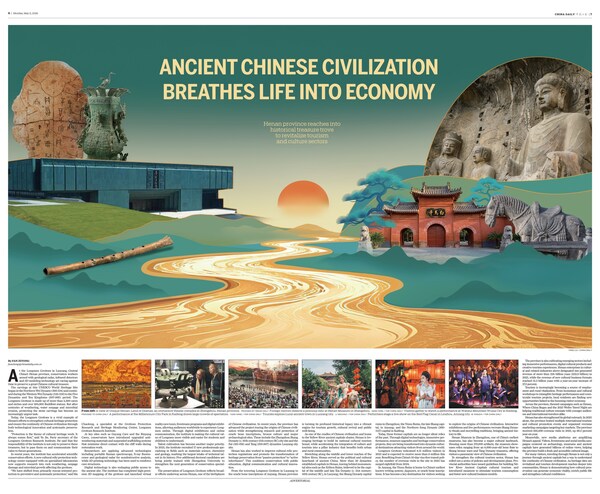
BEIJING, May 11, 2026 /PRNewswire/ — A news report from China Daily:
From advanced manufacturing to cultural heritage preservation, Central China’s Henan is showcasing a new model of high-quality development driven by innovation, openness and cultural confidence.

A spread from China Daily showcases the high-quality development of Henan’s cultural industry.
In Luoyang city, Luoyang Bearing Group or LYC, has become a symbol of the province’s industrial transformation. Its high-end bearings are now widely used in offshore wind power, new energy vehicles, aerospace and shield tunneling machines, replacing products once dominated by foreign manufacturers.
One of the company’s major breakthroughs came with the development of 16-megawatt offshore wind turbine main shaft bearings, which have been installed on the world’s first mass-produced 16-MW offshore wind turbine platform. LYC has also expanded rapidly in the new energy vehicle sector, supplying wheel hub bearings to leading Chinese automakers including BYD.
Inside LYC’s intelligent workshops, automated production lines and digital inspection systems reflect Henan’s broader push toward smart manufacturing, green production and industrial upgrading.
More than 100 kilometers away from Luoyang, the Zhengzhou Airport Economy Zone has emerged as another engine of growth. BYD vehicles produced there are exported via China-Europe freight trains and other international logistics channels, highlighting Henan’s growing role in global supply chains and advanced manufacturing clusters.
At the same time, the province is turning its profound historical legacy into a new driver of tourism and cultural revitalization.
At the Longmen Grottoes, conservation workers are using geological radar, infrared detectors and 3D modeling technology to protect one of China’s greatest cultural treasures. The UNESCO World Heritage Site contains more than 2,300 caves and niches and over 100,000 Buddhist statues.
Digital innovation is also reshaping public access to heritage. High-precision 3D mapping, virtual reality tours and online exhibitions are allowing global audiences to experience Longmen remotely while helping younger generations better understand Chinese civilization.
Across Henan, former ancient capitals and archaeological sites are being revitalized through museum upgrades, immersive cultural experiences and heritage conservation projects. Tourism and cultural industries have become important sources of economic growth, employment and rural revitalization.


Chris Sununu, Airlines for America president and CEO and former New Hampshire governor, joins ‘Squawk Box’ to discuss the state of the airline industry, impact of rising jet fuel prices on airfares, and more.
07:37
an hour ago

Blogchicks is your lifestyle news, entertainment, travel, music, health & fashion website. We provide you with the latest breaking news and videos, something for everyone.
Contact us: info@blogchicks.com.au
© Blog Chicks 2024